In this article 4
If you are having a new website made, you broadly choose between three routes: putting a site together yourself in a website builder, having a standard system set up with a purchased theme and add-ons, or having a website designed and built for you. Prices vary widely, but the real differences only show after launch: how fast the site is, how far it can grow with you and who is in control of it.
To be clear: we build custom websites. Even so, a custom build is not the best choice for every business, and we explain why below. That way you can judge for yourself which route fits your situation.
Three routes side by side
- Website builder: an online platform where you assemble pages yourself from ready-made blocks. Quick and cheap to start with, but you are renting the site: hosting, features and design stay with the platform.
- Theme with add-ons: a standard content management system with a purchased design and separate add-ons for forms, languages or a shop. More flexible, but the design and the technology are made for thousands of sites at once.
- Custom build: design, structure and features are made for your business. The initial investment is higher, but everything on the site is there for a reason, and you own the code.
All three can produce a tidy website. The difference lies in how well they fit what your site needs to do, now and three years from now.
When off-the-shelf is enough
An off-the-shelf solution is a reasonable choice if your website is mainly a business card: a few pages with your services, contact details and perhaps a photo gallery. For a temporary site, such as an event or a test of a new product, speed also matters more than perfection. Off-the-shelf usually fits if:
- the site has few pages and rarely changes
- you do not need integrations with other systems
- search visibility and speed are not an important source of new clients
- you accept that the design will resemble that of other companies
- you are prepared to spend your own time building and managing it
Do factor in the running costs, though. Subscriptions, paid add-ons and premium themes cost money every year, and some website builders charge extra for features or languages. Added up over several years, the difference from a custom build is often smaller than the starting price suggests.
A middle way: start small. A custom build does not have to be large. A compact site with the pages that really matter, built on a foundation that can later be extended with languages, integrations or a client portal, saves you from starting over in two years' time.
Where off-the-shelf starts to pinch
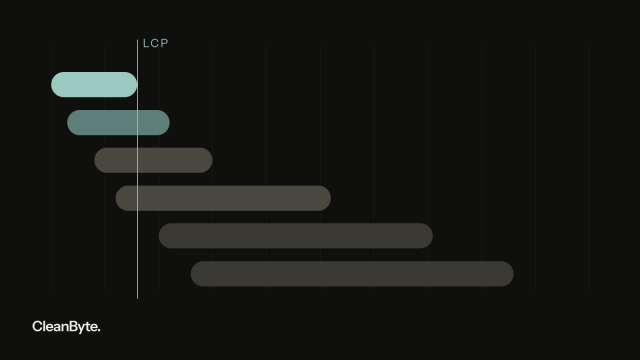
Speed. A theme that has to suit everyone loads code for features you never use: sliders, animations, dozens of font variants. That shows in the Core Web Vitals, and therefore in how visitors and search engines experience your site. A custom site loads only what is on the page.
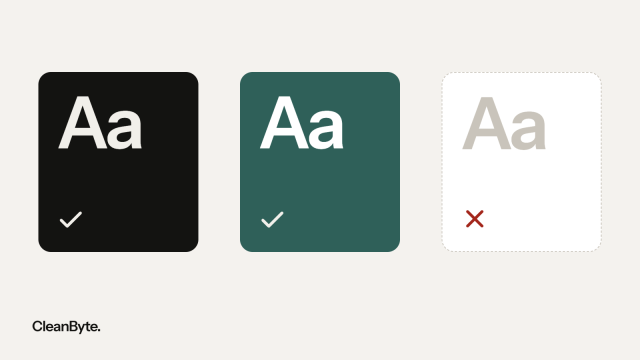
Accessibility. The European Accessibility Act has applied since 28 June 2025, and for companies that sell online to consumers WCAG 2.2 AA is now a requirement. Not every theme or building block reaches that level: too little contrast, no visible focus, buttons without an accessible name. Fixing that afterwards in someone else's code is difficult; with a custom build it is part of the foundation from the design stage.
Integrations and processes. As soon as the website needs to do more than inform, such as passing quotes to your CRM, letting clients log in, showing availability or generating invoices, off-the-shelf becomes a stack of add-ons from different makers. Every update can then break something. E-invoicing is also becoming mandatory in more EU countries: Belgium has required structured e-invoices via Peppol between businesses since 1 January 2026, and Germany is phasing in the obligation to issue e-invoices from 2027. If your client portal generates invoices, it has to support these formats.
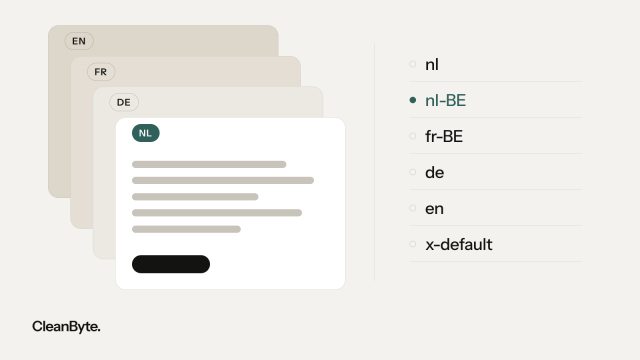
Languages and identity. A site in Dutch, French, English or German needs more than a translate button: a separate address per language, hreflang annotations and copy that is right for each market. And a design your competitor also uses makes it hard to stand out to business buyers who compare three suppliers side by side.
Management. A website builder or theme gives editors a lot of freedom: every colour, font and block can be changed. That seems convenient, but after a few years and a few editors every page looks different. With a custom build, the admin area offers exactly the fields that are needed: a title, a text, an image with alt text. The design stays consistent, and new colleagues get up to speed faster.
Ownership and privacy. With a website builder you rent the site; if you stop the subscription, the site stops too. Depending on the provider, your data may also be stored outside the EU, which belongs in your privacy policy and your GDPR assessment. With a custom build the code is yours, you choose the hosting, and another developer can take over the work if that is ever needed.
How to make the choice
Five questions that usually tip the balance:
- What does the website need to deliver: just visibility and contact details, or enquiries, sales or a client portal?
- Which systems does the site need to exchange data with, now or within a few years?
- In how many languages, and for which markets?
- Does the site need to meet WCAG 2.2 AA, for example because you sell to consumers or supply public bodies?
- How long does the site need to last, and who should be able to take it over if your supplier stops?
If the answers are simple, an off-the-shelf solution is often enough. If integrations, several languages, accessibility requirements or growth plans come into play, a custom build usually pays for itself within a few years: fewer add-ons to maintain, a faster site and no platform limits.
This is how we work: we design and build every website from a blank page on Laravel, a widely used PHP framework, with an admin area that fits your content exactly. After an intake you receive one fixed price, and you own 100% of the code. In that intake we also check whether a custom build really is the best choice for your situation.
Last updated